Nur
Nur are considered a relative by the Winnemem Wintu people. Known as salmon in English, Nur bring essential nutrients and medicines to waterways, forests, and lands, securing the ecological integrity of our watersheds.
Historic Extent of Nur
Reintroduction of Nur on the Winnemem Waywaket
Chinook Salmon
Publications about Nur (winter-run Chinook Salmon, Oncorhynchus tshawyscha) in the Sacramento River watershed.
-
The Recovery Plan establishes a strategic approach to recovery, which identifies and prioritizes recovery actions at the Statewide, Central Valley wide, and site-specific levels.
-
An Analysis of the Effectiveness of the Mitigation Plan for Shasta and Keswick Dams
The purpose of this report is to assess what the anadromous fish resources in the upper Sacramento River system were prior to construction of Shasta and Keswick Dams and to evaluate the effectiveness of mitigation measures designed to compensate for the loss of these resources. Information provided by this report is intended to assist the reader in answering questions regarding the specific nature and extent of mitigation requirements, including hatchery production goals and habitat maintenance. Such questions include:
-
This paper recasts the narrative by foregrounding the oral history of the Winnemem Wintu, who contend Stone learned from them about salmon biology but ignored their most important lessons: that salmon are sentient bearers of ecological wisdom who must be followed rather than controlled and that hatcheries cannot replace the protection of riverine habitat.
-
Historical and Present Distribution of Chinook Salmon in the Central Valley Drainage of California
This report compiles information from historical narratives and ethnographic accounts, fishery records and locations of in-stream natural barriers to determine the historical distributional limits and, secondarily, to describe at least qualitatively the abundances of chinook salmon within the major salmon-producing Central Valley watersheds. Indi- vidual synopses are given for each of the larger streams that histori- cally supported or currently support salmon runs.
-
This study investigates the impact of side channel restorations on juvenile salmon abundance and density.
-
In this framework, reservoir operations shift from mimicking historical temperature patterns to operations that target cold-water releases to the transient appearance of embryo critical windows across the riverine habitat.
Side Channel Restoration on the Sacramento River
Throwin’ good money after… warm water
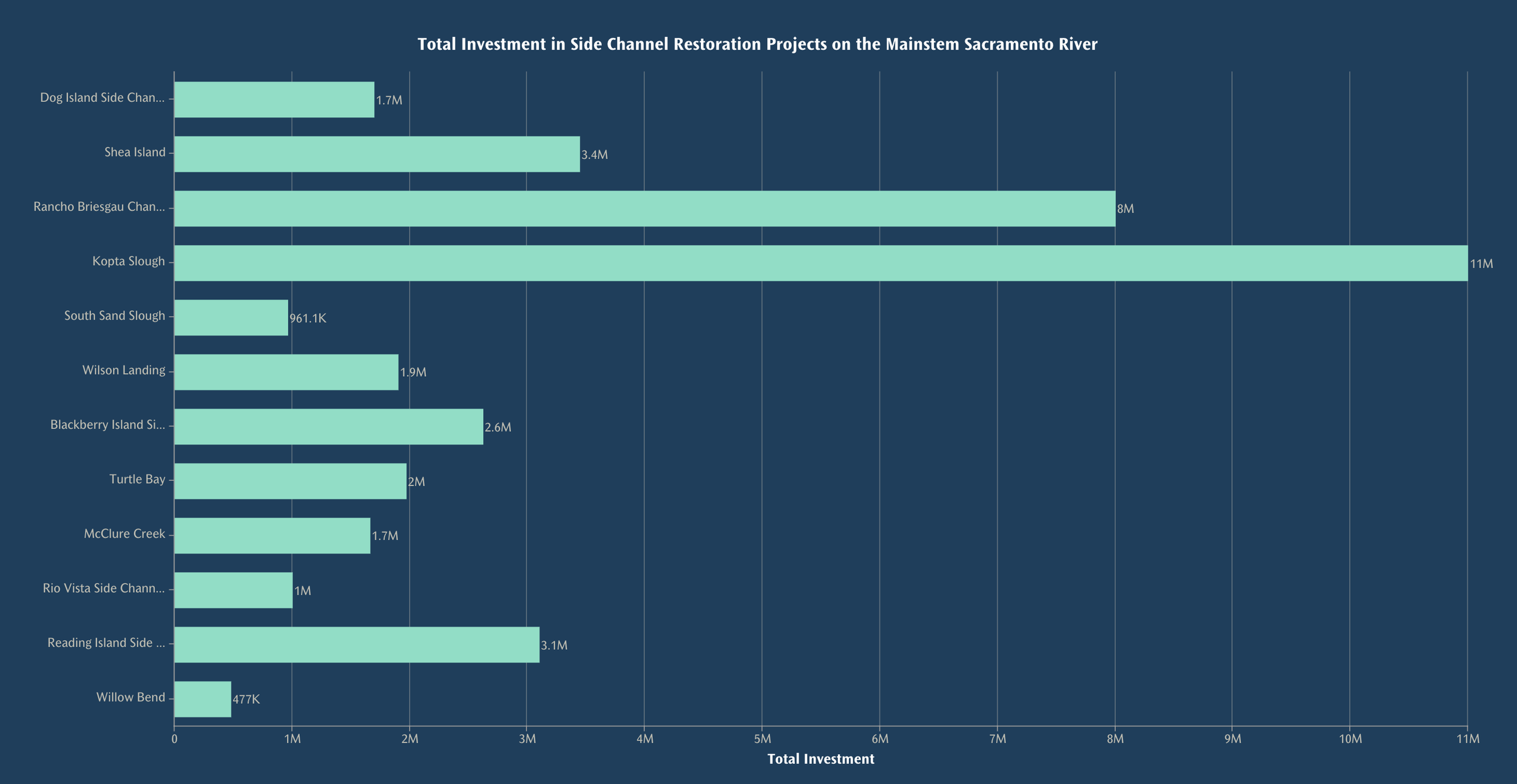
In the past decade, millions of dollars have been invested into reconnecting side channels along the mainstem of the Sacramento River in the name of salmon restoration.
A 2021 study concluded that the benefit of side channel restoration was not statistically significant for the abundance or density of winter-run Chinook salmon (Neilsen, 2021). Below is an incomplete list of side-channel restoration projects, representing no less than $38 million conservation dollars invested in warm-water habitat for a cold-water fish.
While these projects are important elements of habitat connectivity, it might be worthwhile to consider a new approach to expanding habitat.